
Valentina Ekimova, PhD
University of Virginia (USA)
What’s the work that you do?
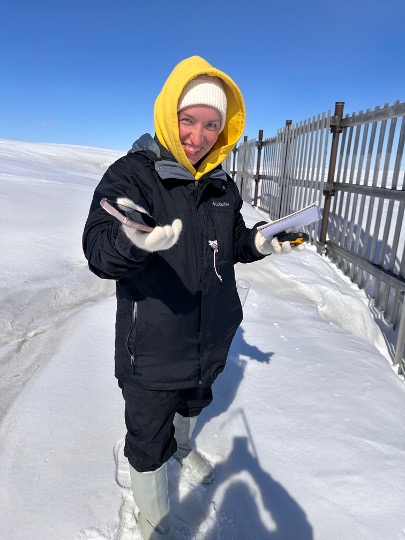
I study how Arctic permafrost responds to climate warming and how these changes affect infrastructure, hydrology, and water quality. My work combines field observations, near-surface geophysics (electrical resistivity tomography and ground-penetrating radar), micrometeorological data, and satellite imagery. In Utqiaġvik, Alaska, I quantify how snow redistribution and surface disturbance influence permafrost dynamics, resulting in changes in thaw depth, ground stability, ponding, and lake and lagoon chemistry. The goal is to connect process understanding with practical indicators that support monitoring and risk reduction for Arctic communities.
What keeps you going?
I have always loved observing how nature works, and that curiosity brought me to science. Even when fieldwork and research are physically and mentally demanding, the excitement of new results, experiments, and data analysis is deeply rewarding. Joining a project where we work closely with Arctic communities has strengthened this motivation even more. It helps me see who this work is for and why it matters, and I learn a great deal from local knowledge about changes on the ground observed over generations. Walking into the field through wind and snow, knowing it is not science for the sake of science, is one of the most meaningful parts of my work.
What’s your message to the world?
Going to the Arctic reminds us how extraordinary this planet is, and how quickly it can change. It is a place where the landscape feels alive: snow becomes water, water becomes ice, and the ground itself can shift beneath your feet. The Arctic teaches you to pay attention, because small changes are never really small there.
Yes, the world has many serious problems. But change begins with us, and every small step matters. I hope that each piece of work we do in the Arctic, each dataset, each field season, and each careful measurement can help communities living on permafrost landscapes navigate the dramatic changes happening now. At the very least, I hope it can support adaptation in ways that are practical, thoughtful, and respectful of local knowledge.
Believing in the future of this planet, and in the value of science, feels especially real when you stand for a moment on the shore of the Arctic Ocean. The wind is sharp, the horizon is endless, and you realize how much is worth protecting.
Organisation: University of Virginia (USA)
Nationality:
 Russia
Disciplines:
Connect: