
Nina Purvis, MPhys, MBBS, MSc, PhD
National Health Service (NHS); European Space Agency (ESA)
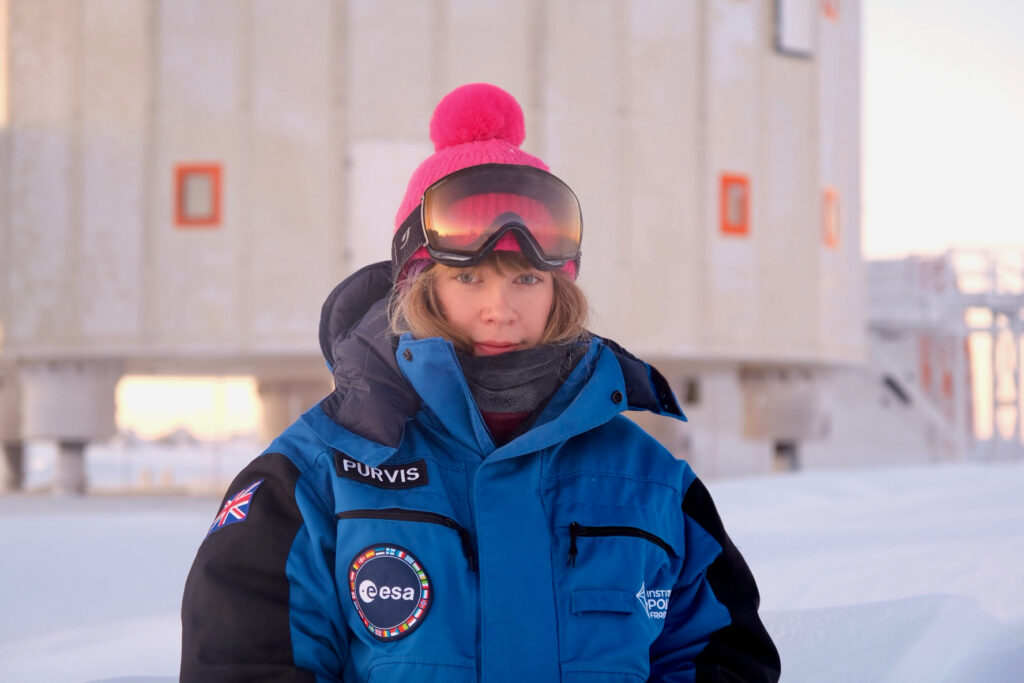
Dr Nina Purvis during the last sunset over Concordia Station, Antarctica before the polar night, May 2025.
What’s the work that you do?
Aside from being a surgical resident, my academic passion is exploration class spaceflight. My background in astrophysics and medicine has allowed me to work on problems such as surgical emergencies and blood clots in space. This took me to Antarctica for 13 months, on behalf of the European Space Agency, to Concordia Station (known as “White Mars”) – one of the most remote and dangerous research stations on the continent. I studied how the crew & myself responded to the extreme environment of isolation, confinement and altitude. This work can inform medical plans for astronauts on a mission to Mars. I also served as the crew Search & Rescue Lead/MD and monitored our life support water system.
What keeps you going?
Whenever I get a rejection or redirection, or return from an intense experience like my mission to Concordia Station, I always think that my teenage self would be so in awe of the science and adventure I’ve been part of, and that’s the most important thing: making the most of life, being true to yourself and making progress even if the path isn’t straightforward. I love space medicine as not only does it inspire, foster exploration, and enable extreme science but also helps terrestrial patients in everything from portable imaging to tele-medical capabilities. Antarctica is the perfect test-bed for space medicine and making progress in hospitals too.
What’s your message to the world?
Astronauts who travel into space speak of what they call the ‘The Overview Effect’: a recognition of our cosmic isolation, followed by an undeniable urge to protect the Earth. Antarctica gives you a similar terrestrial version of this – the vast expanse of ice desert, the milky way so bright you can see your shadow, the dancing aurora. You realise your place in things – important and insignificant all at once. I like to live by the mantra; you can’t be all the good the world needs but the world needs all the good you can do. My 13-month mission really aligned my priorities and world view, it was like a reset in my brain and I was sure of the work I was doing.
Organisation: National Health Service (NHS); European Space Agency (ESA)
Nationality:
 Great Britain
Disciplines: