
Emma Ferrari, PhD
University of Siena (Italy)
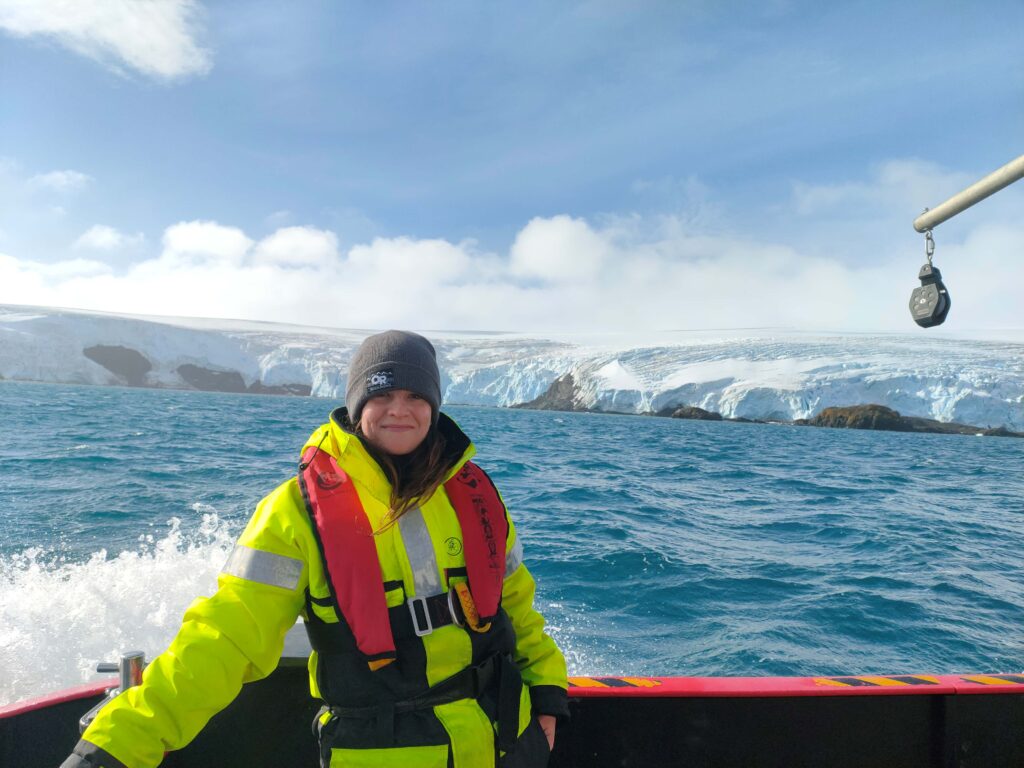
Emma, in reflective gear and a life jacket, is on a vessel. The photo was taken on King George Island (Antarctic Peninsula) close to the Collins Glacier during fieldwork activities related to sampling marine surface waters to identify and quantify plastic presence.
What’s the work that you do?
I’m a research fellow at the University of Siena, currently involved in two international research projects focused on monitoring plastic pollution in the Antarctic Peninsula. My work specifically investigates the distribution and impacts of anthropogenic microfibers within marine ecosystems, with particular attention to marine invertebrates. In addition, I study terrestrial environments by assessing the distribution of macroplastics and their effects on soil organisms. The overarching aim of these two projects is to identify sources of contamination and support the development of policy and regulatory frameworks, particularly in relation to scientific and research infrastructures.
What keeps you going?
What I like the most about my job is the sense of purpose behind it. Studying plastic pollution in such remote and fragile environments as the Antarctic Peninsula mean contributing to knowledge where data are still limited, but urgently needed. I do this work because I’m motivated by the idea that research can make a tangible difference. By identifying contamination sources and understanding their impacts on marine and terrestrial organisms, I hope to contribute to better environmental management and more effective policies. Ultimately, it’s about helping protect ecosystems that cannot advocate for themselves, while supporting science that can inform real-world decisions.
What’s your message to the world?
My message is simple: there is no such thing as “far away” anymore. The Antarctic continent feels remote, untouched and symbolic of wilderness, but even there we find the footprints of our daily choices in the form of plastic pollution. What we produce, use, and discard doesn’t disappear; it travels, persists, and accumulates in the most unexpected places. If we want to protect these environments, we need to rethink our relationship with materials, consumption, and responsibility. Because in the end, protecting the most remote ecosystems means taking responsibility everywhere.
Organisation: University of Siena (Italy)
Nationality:
 Italy
Italy
Disciplines: