Colombina Valdés Valenzuela
NGO Lafken-lif (Chile)
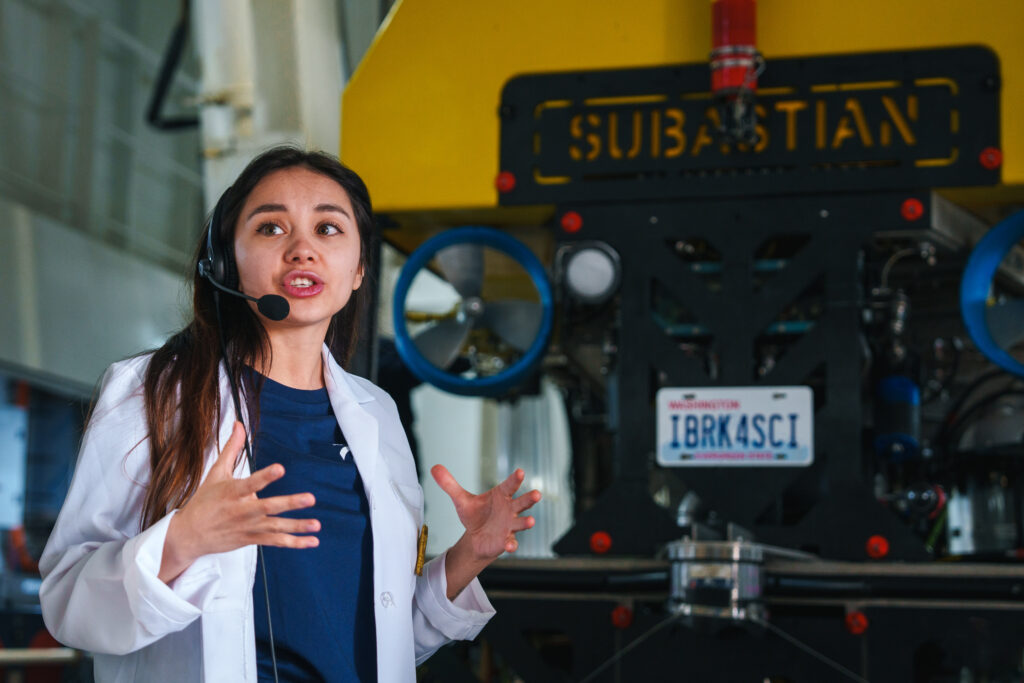
Colombina Valenzuela (Marine Biologist, Austral University of Chile) speaks to a local school from the Chaitén community during a ship-to-shore. Here, she shows them ROV SuBastian.
What’s the work that you do?
I am a marine biologist and science communicator, specialized in biological oceanography and polar ecosystems. My research focuses on carbon fluxes, glacial melting, and their effects on phytoplankton and climate change in Antarctica, particularly in coastal systems such as Fildes Bay and South Bay. In parallel, I design and implement polar education programs (Antarctica/Arctic) for foundations and schools, with a focus on underserved communities. My work aims to democratize scientific knowledge by connecting research with meaningful educational experiences that bring science closer to students, foster critical thinking, and open windows of opportunity, beyond simply inspiring STEM vocations.
What keeps you going?
I am driven to bridge the gap between science and society. In contexts like Chile and Latin America, education can transform life trajectories, yet access remains deeply unequal. Much of our research is publicly funded, and I believe we have an ethical responsibility to return that knowledge to society. While many scientists face demanding systems that leave little time for outreach, for me this is both a conviction and a passion. I work so that more children can see themselves as future scientists and understand that science belongs to them. I am also inspired by understanding how polar ecosystems function and communicating their relevance to everyday life.
What’s your message to the world?
Science should not be a privilege, it is a right. Polar ecosystems may seem distant, yet they shape fundamental processes that sustain life on Earth, from climate regulation to the water we depend on. If we are to confront global challenges, we need more people who understand, value, and actively engage with science. Science is not confined to laboratories; it begins with curiosity about the world around us.
In Latin America, this also means addressing structural inequalities in access to knowledge. Curiosity is universal, but opportunity is not. Transforming that reality requires intention, commitment, and collective action. Bringing science to every territory, especially those historically excluded, is not just outreach; it is a matter of equity and justice.
Organisation: NGO Lafken-lif (Chile)
Nationality:
 Chile
Chile
Disciplines:
Connect: