Emily Rowlands, PhD
British Antarctic Survey (BAS), UK
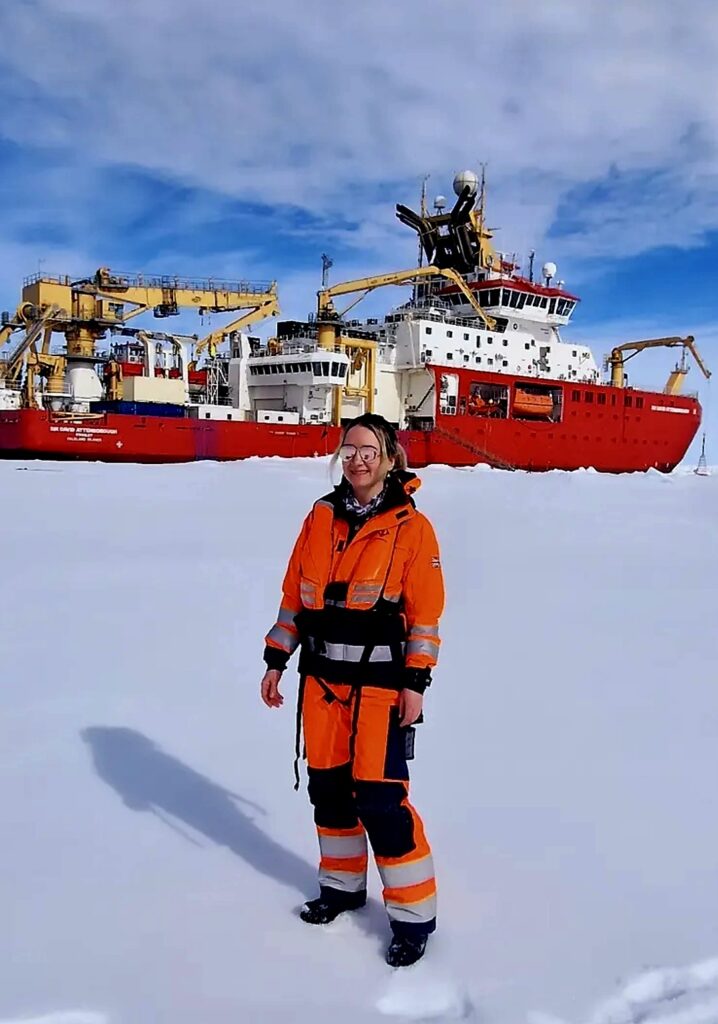
Emily is on an ice floe in Antarctica, with a ship behind her.
What’s the work that you do?
As an extremophile polar biologist, my research investigates how plastic pollution interacts with climate-related stressors to affect marine ecosystems. During my PhD, I demonstrated that Antarctic krill embryos experienced reduced development under combined nanoplastic and ocean acidification conditions, highlighting the importance of studying multiple stressors. I also quantified vertical microplastic flux in the Southern Ocean, demonstrating plastic transport throughout the water column. As a postdoctoral researcher on the CUPIDO project at the British Antarctic Survey, I investigate how zooplankton transport plastics and how plastic pollution may disrupt the biological carbon pump, informing ecological models and conservation policy.
What keeps you going?
What keeps me going is the opportunity to explore some of the most remote and extreme environments on Earth and uncover the changes happening within these fragile ecosystems. Working in polar regions provides a unique perspective on our planet, but I am equally motivated by bringing these discoveries back to wider audiences. Communicating the importance of these environments, the threats they face, and their role in regulating our global climate is a privilege. I hope that by sharing scientific knowledge, I can inspire action and help ensure these extraordinary ecosystems are protected for future generations.
What’s your message to the world?
The polar regions may feel distant, but they are deeply connected to every one of us. The choices we make, the values we hold, and the way we interact with our planet all contribute to the future of these extraordinary environments. Whilst global policies and collective action are essential for meaningful change, individual attitudes and everyday decisions also matter. Protecting our planet is not only about conserving remote landscapes; it is about recognising our shared responsibility for the Earth’s interconnected systems. Small actions, multiplied across communities, can help drive the cultural change needed to safeguard our planet for generations to come.
Organisation: British Antarctic Survey (BAS), UK
Nationality:
 UK
UK
Disciplines: