Evelyn Krojmal, MSc
Centro Universitario Regional del Este, Universidad de la Republica, Maldonado (Uruguay)
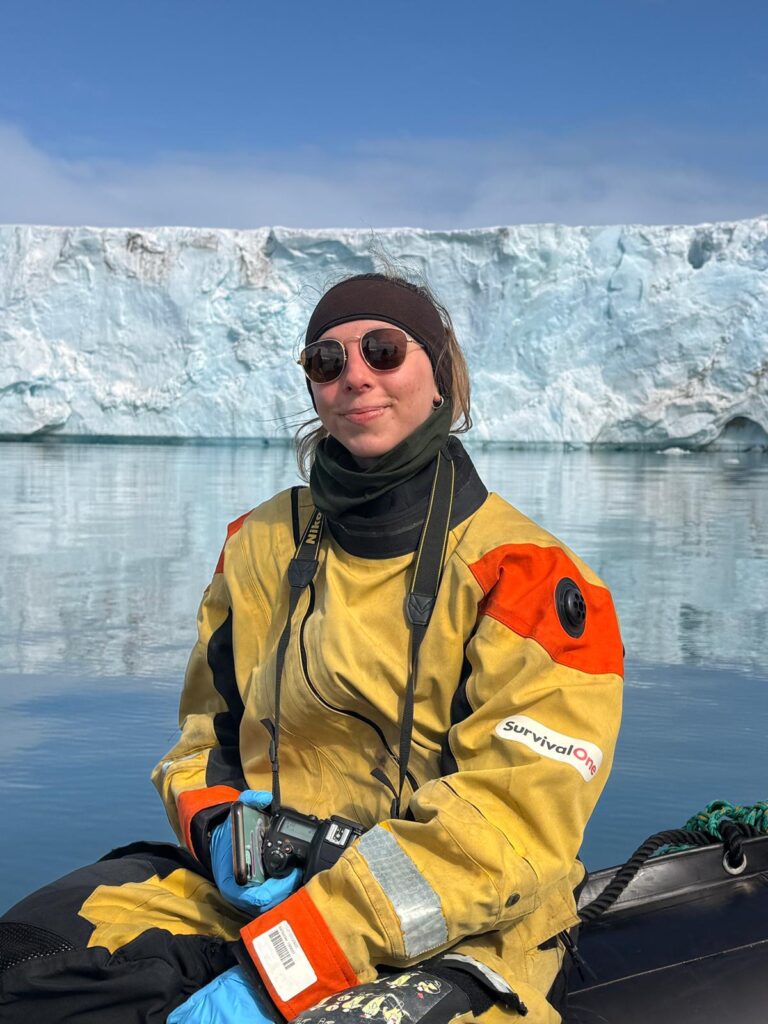
The photo was taken near Nelson Glacier, Fildes Peninsula, King George/25 de Mayo Island, Antarctica, during January 2026, in the context of Evelyn's activities as Scientific Coordinator at Uruguay’s Artigas Antarctic Scientific Base (BCAA).
What’s the work that you do?
I’m a biologist and researcher specializing in microplastic pollution in aquatic ecosystems, with a focus on Antarctic, freshwater, and coastal environments. My academic training (Master’s and ongoing PhD) centers on the ecological impacts of microplastics. I have participated in four Antarctic research projects and twice served as Scientific Coordinator at Uruguay’s Artigas Antarctic Scientific Base, organizing logistics and sampling activities for multiple scientific teams. My PhD is linked to the “Uruguay SUB200” program and an international expedition aboard the R/V Falkor (too) with the Schmidt Ocean Institute. I also work in ecotoxicology, environmental monitoring, and science communication for both academic and public audiences.
What keeps you going?
What motivates me most is the diversity of my work and the possibility of connecting science with people. I enjoy the balance between fieldwork, laboratory research, teaching, and science communication. One day I can be sampling in Antarctica or at sea, and another explaining environmental issues in schools or through social media. I believe science should not remain only within academia, but also reach society in accessible and engaging ways. Working on environmental pollution in remote ecosystems constantly reminds me of how interconnected our planet is and how important it is to communicate, collaborate, and inspire action through science.
What’s your message to the world?
The polar regions are often perceived as distant and untouched, yet they reflect many of the environmental challenges created by human activity. Finding microplastics in Antarctic ecosystems reminds us that no place on Earth is truly isolated. At the same time, these environments show us the value of international collaboration, curiosity, and resilience. I believe science is not only about generating knowledge, but also about building connections between disciplines, countries, and people. By making science more accessible and visible, especially for younger generations and women, we can inspire more inclusive and collective action toward protecting our planet.
Organisation: Centro Universitario Regional del Este, Universidad de la Republica, Maldonado (Uruguay)
Nationality:
 Uruguay
Disciplines: