Claudia Paz Sánchez Alvarez, PhD
Istituto Nazionale di Geofisica e Vulcanologia, INGV (Italy)
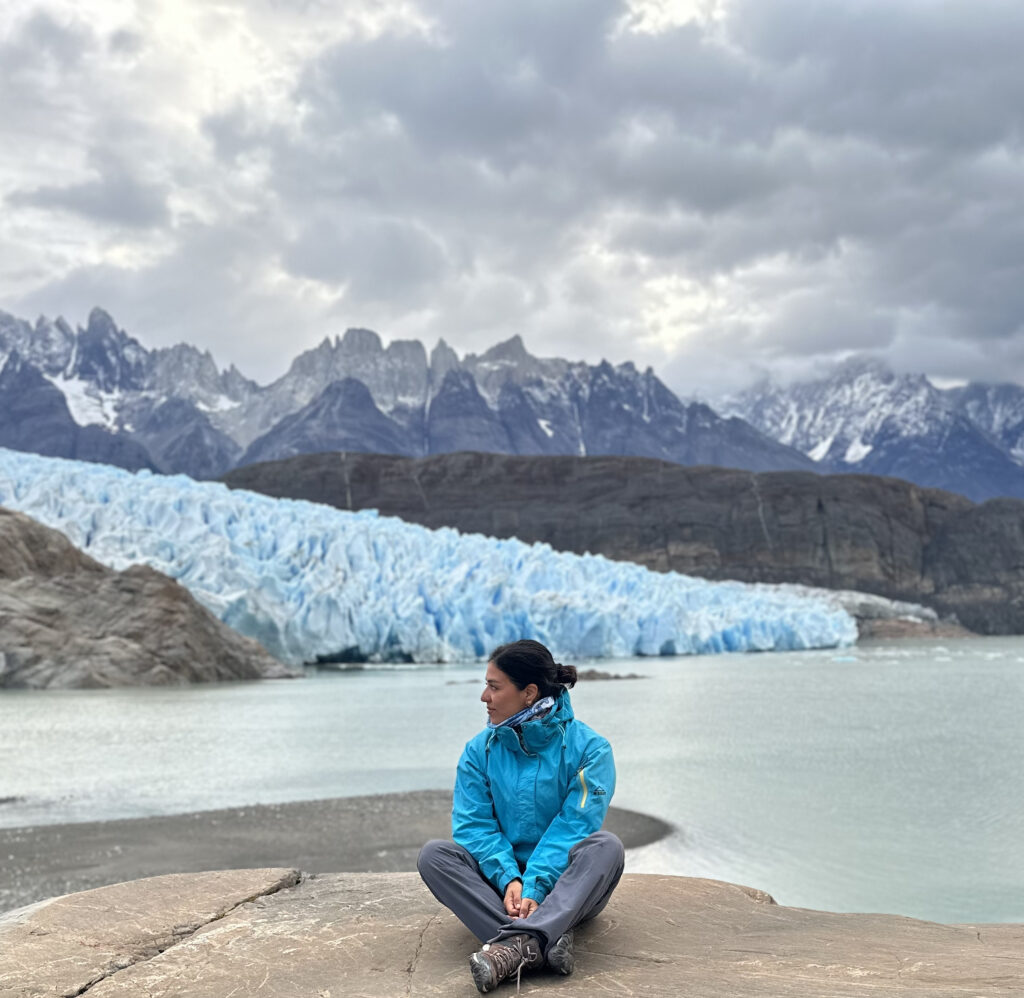
Claudia sits in front of a body of glacial water, with a mountain range in the background and a glacier in the middle. This photo was taken at Grey Glacier in Chilean Patagonia, a remote sub-Antarctic region, at the site where she installed an infrasound array to study the acoustic signals generated by the glacier, particularly those associated with calving events.
What’s the work that you do?
I am an experimental physicist working on the dynamics of geophysical systems, particularly glaciers and volcanoes. My work focuses on field measurements in remote and extreme environments, with a strong emphasis on glacier monitoring in Patagonia, in the sub-Antartic region. I use acoustic signals, including infrasound, to capture processes such as glacier calving. By linking these signals to the underlying physics, I aim to better understand how these systems behave and respond to environmental change, and to contribute to the development of non-intrusive monitoring techniques in such remote environments.
What keeps you going?
What keeps me going is curiosity and the chance to explore how the Earth behaves in extreme environments. I really enjoy working in the field, especially in places like Patagonia, which, while not Antarctica, is a sub-Antarctic system with its own unique dynamics. Being there allows you to directly experience the processes you study. There is something powerful about recording signals from a glacier and realising that they can reveal and give us so much information. I am also motivated by the possibility that this work can contribute to understanding environmental change and improving how we monitor these systems in real time and in high resolution.
What’s your message to the world?
We often think of polar and sub-Antarctic regions as remote and distant, but they are deeply connected to the rest of the planet—and to Antarctica itself. Changes happening in these environments are not isolated; they affect global systems, from sea level to ecosystems.
For me, working in these places is not only about understanding how they function, but also about finding new ways to observe and protect them. If we learn to listen more carefully—sometimes quite literally, through the sounds of calving—we can better understand the changes we are facing and make more informed decisions for the future.
Organisation: Istituto Nazionale di Geofisica e Vulcanologia, INGV (Italy)
Nationality:
 Chile
Disciplines:
Connect: