Catarina Frazão Santos, PhD
University of Lisbon (Portugal)
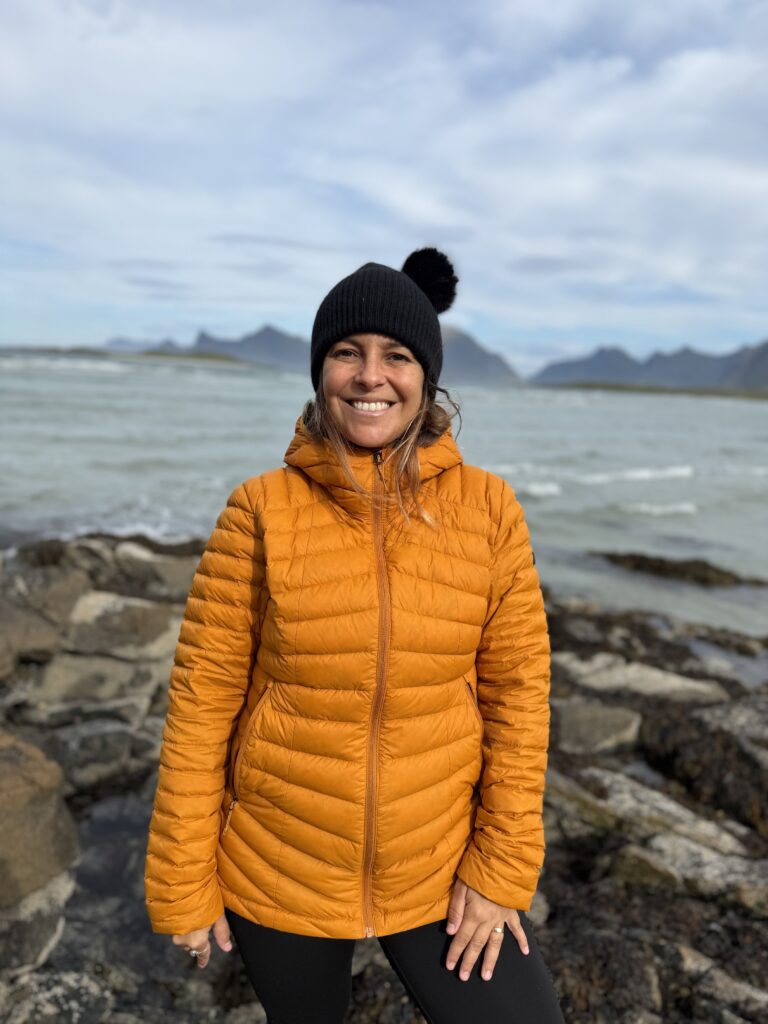
Catarina, in an orange puffer jacket and a black hat, is inside the Arctic Circle, in the Lofoten Islands, Norway — right after the SCAR Open Science Conference 2026.
What’s the work that you do?
My research focuses on sustainable ocean planning and governance under global environmental and social change. I am leading project PLAnT, “Planning for Sustainable Ocean Use in Antarctica under Global Change”, funded by the European Research Council (ERC Starting Grant), to investigate the benefits and challenges of developing climate-smart marine spatial planning in the Southern Ocean, taking an interdisciplinary, ecosystem-based and holistic approach. I am an interdisciplinary scientist (background in marine biology and a PhD in ocean policy), an Associate Professor with Habilitation at the University of Lisbon (Department of Biology, Faculty of Sciences), and a senior researcher at MARE/ARNET.
What keeps you going?
I have worked on ecosystem-based, climate-smart marine spatial planning (MSP) for a long time (17 years). But looking at it through a polar lens and investigating how MSP can contribute to the conservation and sustainable use of marine polar regions is inspiring in a different, deeper way. As a marine biologist, feeling connected to nature is what keeps me going (even if I spend most of my time at the computer). So, being able to contribute—even if only slightly—to the health and protection of the Arctic and Southern oceans is something I love and am most grateful for.
What’s your message to the world?
We need to protect the ocean not because we profit from it, but because we depend on it. Without a healthy ocean, there is no healthy planet; and without a healthy planet, there are no healthy human populations. Real sustainability will be possible only if and when we recognise nature as the foundation for long-term socioeconomic development (e.g., tourism and fisheries depend on healthy ecosystems). We need to become stewards of the ocean and protect it. And this will require developing new narratives, raising awareness, building capacity, and changing minds and “hearts”. It will also require recognising complex social-ecological interlinkages and taking an integrated “systems view” that crosses biophysical, social, economic, and political boundaries. As many have said before, “we need to take care of the ocean because it takes care of us”.
Organisation: University of Lisbon (Portugal)
Nationality:
 Portugal
Disciplines: