Blanca Figuerola, PhD
Institute of Marine Sciences, Barcelona (Spain)
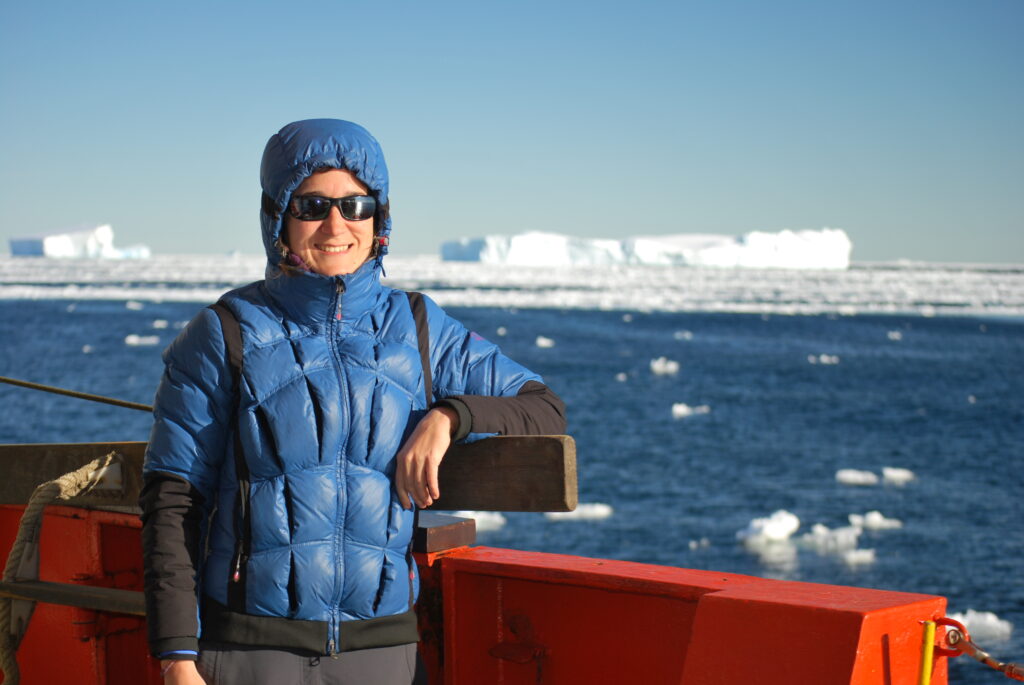
This photo was taken by Javier Cristobo (IEO-CSIC) during the 2016 DISTANTCOM diving expedition to the Antarctic Peninsula aboard the research vessel Hespérides. During this month-long expedition, Blanca Figuerola carried out diving-based sampling of bryozoans for studies on their diversity and ecology in Antarctic benthic ecosystems.
What’s the work that you do?
I study some of the ocean’s quieter architects: benthic invertebrates that build reefs, shells and skeletons, together with the microbial communities that live with them. As a Ramón y Cajal researcher at the Institute of Marine Sciences in Barcelona, I investigate how these organisms respond when the ocean warms, acidifies or becomes increasingly affected by human activities.
I am especially interested in what happens when several pressures act at once. I combine field observations, experiments, molecular tools and the chemical signatures preserved in skeletons to understand both present-day responses and environmental change over much longer timescales. I also study how plastic debris can become a vehicle for marine organisms, including non-native and invasive species.
My work has taken me from Mediterranean coasts to some of the most remote waters on Earth, including the Kerguelen Islands. I have taken part in several Antarctic and sub-Antarctic expeditions, including scientific diving campaigns, and was awarded a COMNAP Fellowship. Today, I also contribute to international initiatives such as MEASO and the Southern Ocean Acidification Hub, where I am part of the leadership team, and I serve on the Executive Committee of Conexión PolarCSIC.
What keeps you going?
What keeps me going is the feeling that the most important ecological changes often begin quietly.
A marine heatwave may first alter the microbes living with an animal. Acidification may subtly change the way a skeleton forms. A piece of plastic drifting at sea may become a raft carrying organisms far beyond their natural range. None of these changes looks dramatic at first, but together they can reshape entire communities. That is what fascinates me: connecting those small signals to the bigger picture.
I also value working across very different environments. Diving in Antarctica or sampling remote sub-Antarctic islands gives you a completely different sense of scale. These places are not untouched, but they can provide invaluable reference points for understanding what ecosystems look like under different levels of human pressure.
And science itself keeps me going: the exchange of ideas, the collaborations that cross disciplines and countries, and those moments when a result suddenly connects pieces that seemed unrelated. For me, understanding change is only part of the job. The other part is making that knowledge useful for conservation, management and society.
What’s your message to the world?
Do not ignore the parts of nature that are easy to overlook. Some of the organisms I work with are small, cryptic or attached to the seafloor. Their microbiomes are invisible to us. Yet they can record environmental change, build habitats, support biodiversity and respond to stress long before the consequences become obvious at the ecosystem level. The same is true of remote places. Antarctica, the deep sea or a distant island may feel disconnected from everyday life, but they are part of the same ocean system that regulates climate, supports biodiversity and connects coastlines across the planet.
One thing I have learned from working in these environments is that change rarely happens in isolation. Warming interacts with acidification. Pollution interacts with biological invasions. Local pressures interact with global ones. If we want to understand where marine ecosystems are heading, we need to look at those connections.
Understanding what is happening in the ocean also means working across disciplines. The changes we are seeing are too complex to be understood from a single perspective, so we need ecologists, microbiologists, biogeochemists, modellers and many others working together to connect the pieces and see the bigger picture.
Organisation: Institute of Marine Sciences, Barcelona (Spain)
Nationality:
 Spain
Disciplines: