
Elisa Palomino Perez, PhD
Smithsonian Arctic Studies Center, National Museum of Natural History (USA)
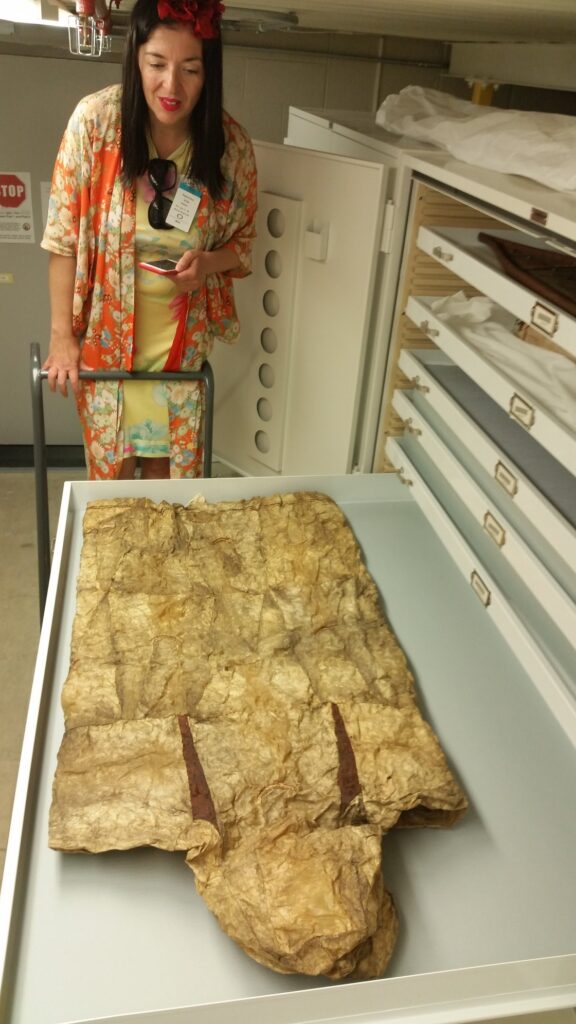
Elisa at the Smithsonian National Museum of Natural History in Washington, DC, during her Fulbright fellowship in 2019. Elisa is examining Arctic fashion artefacts, photographing an Alaska Native gutskin parka as part of her research on Arctic material practices and garment construction.
What’s the work that you do?
I am a Research Associate at the Smithsonian Arctic Studies Center working at the intersection of Arctic anthropology, material culture, and sustainable fashion. My work examines fish skin technologies developed by Indigenous communities across the Arctic, focusing on technical processes, ecological knowledge, and historical circulation. I collaborate with museums and Indigenous Elders to document, analyse, and digitally reconstruct garments, reconnecting collections with source communities while also engaging with contemporary design. I have led EU-funded projects including Horizon 2020 FishSkin and held fellowships at Fulbright, Library of Congress, Ca’ Foscari University, Leiden University, Max Planck Institute, and other international institutions.
What keeps you going?
What keeps me going is the opportunity to work directly with Arctic Indigenous Elders and knowledge holders, and to engage with traditional practices on their own terms. I value research that connects museum collections, archives, and lived knowledge, and that can return information to the communities from which it originates. I am also motivated by the technical aspects of fish skin as a material, and its relevance for sustainable design today. Bringing together research, design, and collaboration across regions gives direction to my work and sustains my commitment.
What’s your message to the world?
Material knowledge matters. The ways people work with animals, plants, and environments are forms of expertise that carry technical, ecological, cultural and spiritual information. These practices should be approached through collaboration, with attention to those who hold and transmit them.
Polar regions are active sites of knowledge, innovation, and exchange. Research in these areas requires care, reciprocity, and long-term engagement.
By working across disciplines and with communities, it is possible to connect past and present practices and to inform more responsible approaches to materials, design, and environmental relations.
Organisation: Smithsonian Arctic Studies Center, National Museum of Natural History (USA)
Nationality:
 Spain
Spain
Disciplines: