
Gomathy M, PhD
Tamil Nadu Agricultural University, India
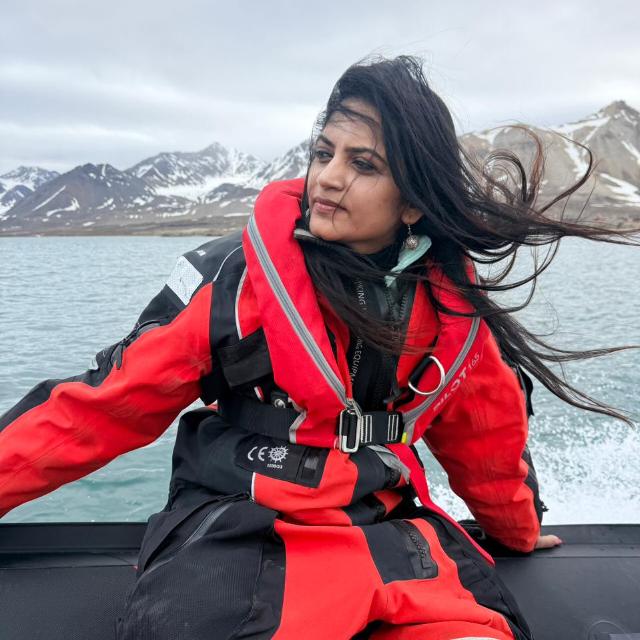
Gomathy, in red polar gear, is in a Zodiac. The photograph was taken in the High Arctic region, Ny Alesund, Svalbard, in the Arctic Ocean on the way to Stockholmen Island for sample collection.
What’s the work that you do?
I am an Associate Professor of Agricultural Microbiology at Tamil Nadu Agricultural University, India. My research explores beneficial plant-associated microorganisms. During India’s 17th Arctic Expedition, I investigated microbial diversity on Arctic terrestrial plants to understand traits that promote stress tolerance and ecosystem resilience. I also developed microbial technologies for sustainable agriculture, including phyllosphere yeast consortium, In vitro production of AM (Arbuscular Mycorrhizal) fungal spores through ROC (Root Organ Culture), sea weed based microbial bio formulations, nano bioformulations and fermentation of food products to enhance vitamins with the goal of translating discoveries from extreme environments into practical solutions for climate-resilient food production.
What keeps you going?
Curiosity and an explorative mind keeps me going. Every expedition reminds me that nature still holds countless untold stories, especially in places as extraordinary as the Arctic. I enjoy connecting field exploration with laboratory discovery and translating fundamental science into solutions that can improve sustainable agriculture and environmental resilience. Knowing that even the microscopic creatures that we know as tiny microbes can inspire innovations for a changing world motivates me every day. Equally inspiring is mentoring students and encouraging more women to pursue science with confidence, determination and a spirit of exploration.
What’s your message to the world?
The Arctic may seem far away, but its story belongs to all of us. The poles are Earth’s silent storytellers. If we learn to listen to the ice, the plants and even the invisible microbes, we learn how life survives against the odds. Every microorganism, every leaf and every ecosystem has something to teach us about resilience, adaptation and coexistence. Science is not merely about discovering answers, it is about asking meaningful questions that can benefit humanity. I believe science is most powerful when it connects people, inspires curiosity and creates hope. I hope more women and young researchers step into the polar regions with curiosity, courage and compassion. When diverse voices explore the world’s most fragile environments, we don’t just advance science, but we shape a more sustainable and inclusive future for our planet.
Organisation: Tamil Nadu Agricultural University, India
Nationality:
 India
India
Disciplines: