
Grace Cordsen
Stanford University (USA)
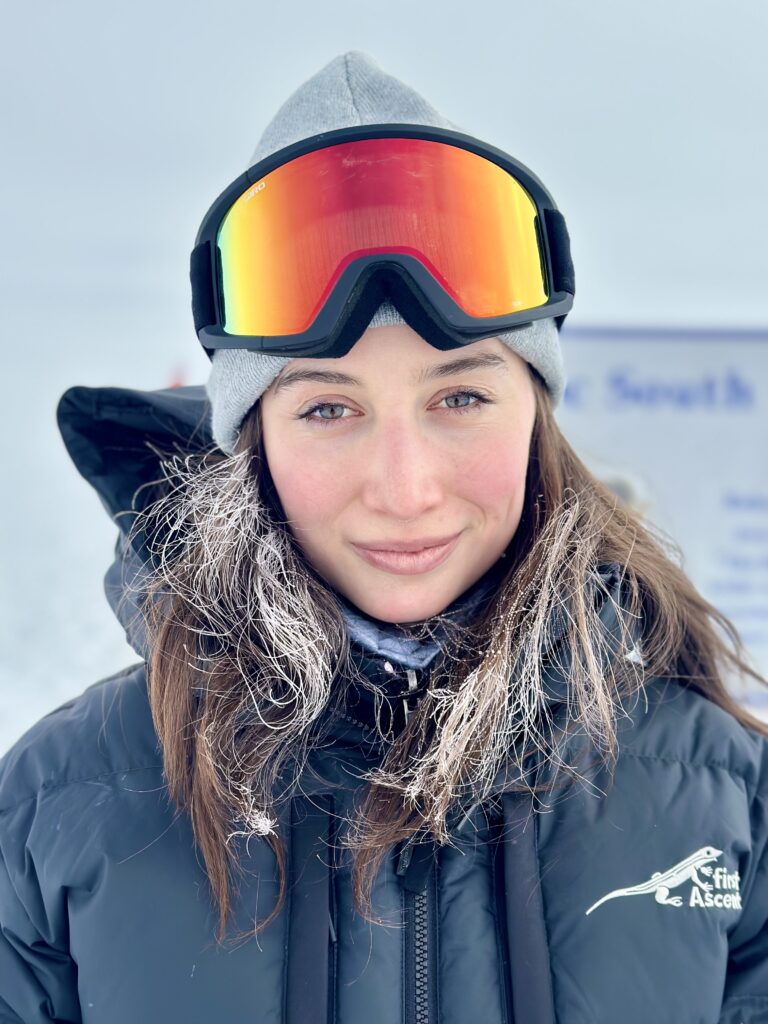
Grace, with ski goggles and iced-over hair, is at the Geographic South pole during a contract as the Camp Manager for White Desert.
What’s the work that you do?
I work at the intersection of polar research, conservation, and storytelling, with experience across both the Arctic and Antarctic in expedition leadership, science communication, and field research. My work focuses on understanding how tourism, heritage, and human presence shape fragile polar ecosystems. I combine methods like ecological sampling, archival research, and longitudinal surveys to study whether educational and science-based tourism can drive measurable environmental and behavioral outcomes. Alongside this, I translate research into public-facing narratives- through journalism, photography, and programming- to bridge science, policy, and broader public engagement on climate change.
What keeps you going?
What keeps me going is the sense that these places – remote, fragile, and often misunderstood – matter far beyond their edges. The polar regions are early warning systems for the planet, but they’re also places where people can still meaningfully shape outcomes in real time. I’m motivated by the chance to connect research with action: to not just document change, but help influence how we respond to it. I also love the mix of fieldwork, science, and storytelling- being out on the ice one day, and translating that experience into something that resonates and drives impact the next.
What’s your message to the world?
The polar regions aren’t distant or disconnected – they shape our oceans, climate, and future in real time. What happens there affects all of us. These places are changing quickly, but they are also some of the last where science, policy, and storytelling can come together to protect what remains.
Organisation: Stanford University (USA)
Nationality:
 USA
USA
Disciplines: