
Jennifer Zhu
Air Inuit
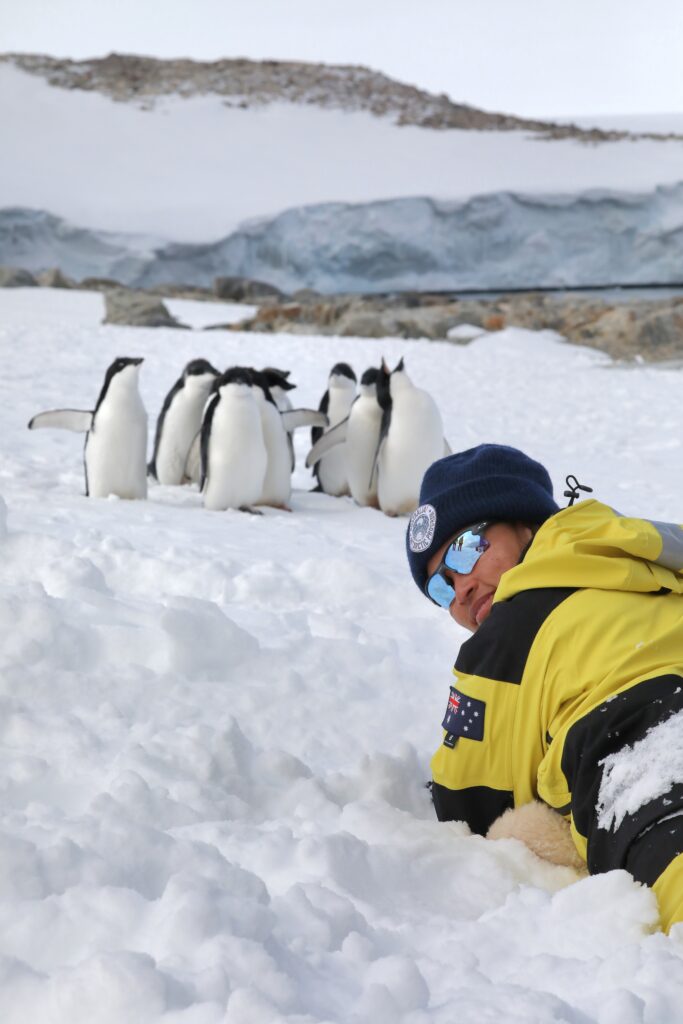
Jennifer is laying on the snow near a group of penguins.
What’s the work that you do?
I work for Air Inuit – in northern Canada which the Inuit call home, I travel across Nunavik, providing leadership, training and support to the network of stations. I oversee passenger, cargo, and ramp operations to keep planes moving in harsh environments, with minimal infrastructure and scarce human resources. I look for ways to improve safety, efficiency and communications across the organisation and in particular for ground operations.
Previously, I worked for the Australian Antarctic Program – on the ice at Casey Research Station, I spent a summer operating the Communications Centre to ensure the safety of personnel travelling by air, sea and in the field. I used HF, VHF and satellite equipment for communication with fixed and rotary winged aircraft, ships, water craft, field parties and field camps.
What keeps you going?
I can’t put my finger on it, but something draws me to places where few people have ventured, where you are at the frontier of human survival. Frigid, harsh environments mean you appreciate and savour the moments where you work together to make something happen. Challenges are constant and unpredictable, every day a new adventure. Sharing unique moments means you forge close connections, and the stories you bring back about your everyday reality are met with disbelief by those who have never been there.
What’s your message to the world?
Watching penguins jump off ice cliffs. Seeing muskox on the tundra. Picking cloudberries on the land. Visiting a husky that lives in an igloo. Seeing the smile on an Inuk mother’s face as she boards the plane with her infant tucked in her hood. Seeing the aurora dance above the ice. I’ve had the privilege of experiencing unforgettable moments that can’t be found anywhere else on Earth.
Organisation: Air Inuit
Nationality:
 Australia, New Zealand, Canada
Disciplines:
Connect: