
Lena Leimgruber Haraldsson, MA
Umeå University, Sweden
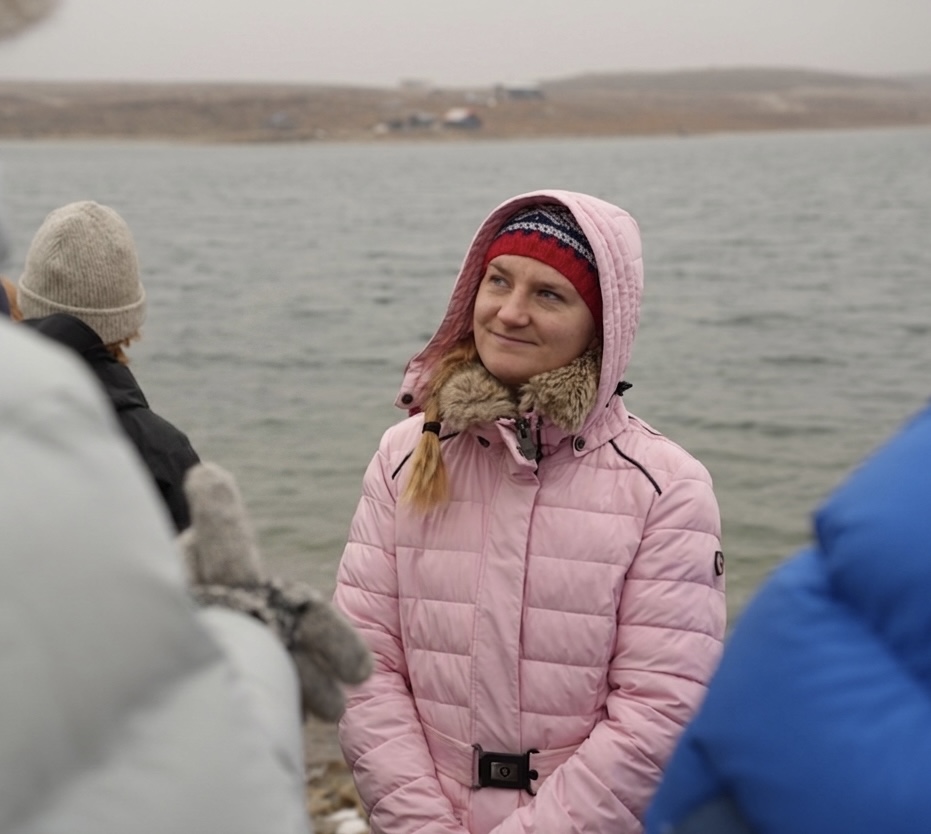
This photo was taken in Cambridge Bay, Nunavut, Canada, during the Arctic Future Pathfinders programme. Lena was part of a four-week expedition along the Northwest Passage, but changing weather conditions meant that the original itinerary had to be adapted. This resulted in the opportunity to spend much more time in Cambridge Bay than originally planned — an unexpected but wonderful part of the journey.
What’s the work that you do?
I’m a PhD researcher in English Literature at Umeå University, Sweden, where I study how contemporary fiction imagines the Arctic. My research explores how novels (and sometimes poetry and short fiction) represent the region in relation to colonial histories, climate and ecological crisis, Indigenous knowledge and more-than-human agency. I’m particularly interested in speculative fiction, climate fiction and ecohorror, and in how these genres challenge familiar ideas of the Arctic as an empty, hostile or purely natural space. Ultimately, I ask what stories can tell us about the Arctic’s past, present and possible futures—and about the relationships between humans, environments and other-than-human worlds.
What keeps you going?
What keeps me going is the belief that we need all disciplines when we talk about the Arctic. No single field can capture the complexity of the region, and I love being part of conversations where we can learn from each other. I have always been an avid reader, so it feels natural to me that literature has a place in these conversations. Fiction can make us imagine places, perspectives and futures that might otherwise remain abstract, so I believe stories have real power to shape how we understand ourselves, each other and the more-than-human world.
What’s your message to the world?
The Arctic is not an empty space at the top of the map. It is a place of histories, communities, stories and more-than-human lives. What happens there matters far beyond the Arctic itself. I believe we need to listen across disciplines, across cultures and across generations if we want to understand the changes taking place there. And I would always advocate for the power of stories: sometimes a novel, poem or short story can make us see a place, a crisis or a future in a way that facts alone cannot.
Organisation: Umeå University, Sweden
Nationality:
 Germany
Disciplines: