Ralica Sabeva, PhD
Sofia University "St. Kliment Ohridski", Bulgaria
What’s the work that you do?
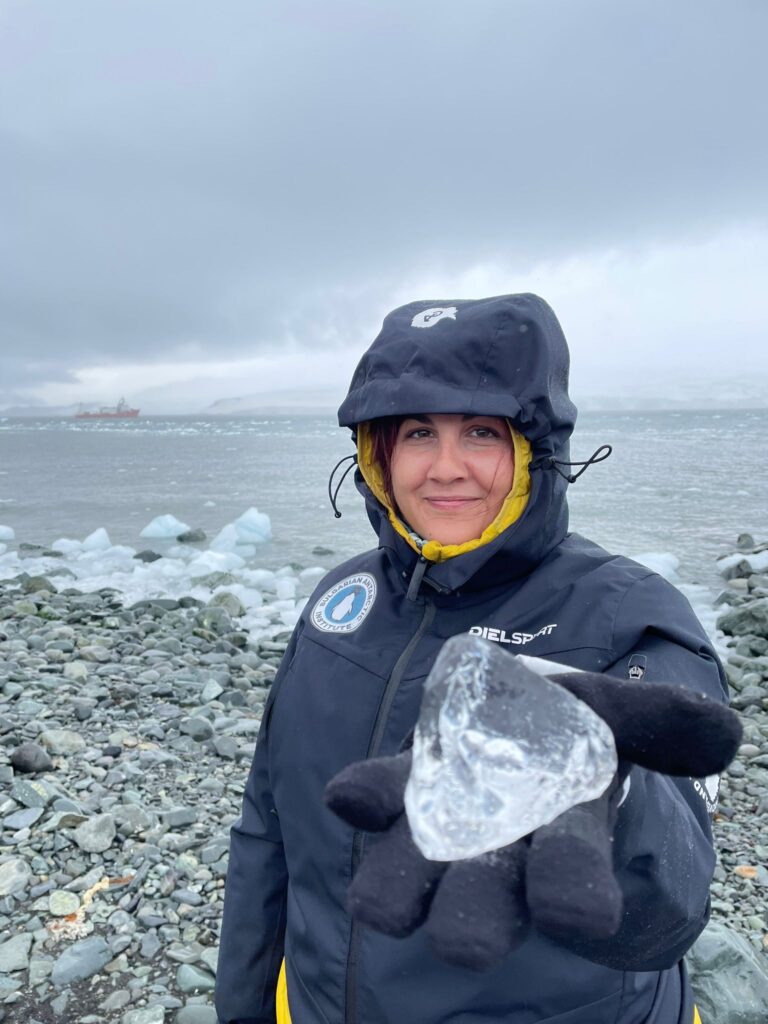
I am an Assistant Professor (PhD) teaching Economic Geology and Ore Mineralogy at Sofia University. I work with geology students and young explorers of natural resources, and I love creating courses that connect minerals, fieldwork, and real-world applications. My polar research focuses on ore mineralization on Livingston Island, where I first identified gold and helped place the island within the broader Andean metallogenic story. Antarctica shaped me as a scientist—it taught me resilience, curiosity, and responsibility toward our planet. As Chair of APECS Bulgaria, I strive to open the polar world to students, schools, and the public through education and outreach.
What keeps you going?
What keeps me going is the mix of discovery, purpose, and people. Geology lets me read the Earth’s stories, and Antarctica opened my world—there I found friends, collaborators, and new inspiration. The polar field teaches balance: between ambition and humility, curiosity and responsibility. I love watching students’ curiosity ignite, when a mineral or map suddenly “clicks.” Research drives me because every dataset reveals a fragment of a bigger picture. Working in Antarctica showed me how meaningful science becomes when it connects people and ideas. Through teaching, research, and outreach, I try to keep that spark alive and pass it forward.
What’s your message to the world?
My message to the world is that geology matters. Nowhere is this clearer than in Antarctica, where every ridge, mineral vein, and shifting ice sheet reveals how our planet works. Understanding Earth’s processes is not abstract knowledge—it is the key to knowing our own home. The polar regions remind us that balance is fragile: between resources and responsibility, exploration and preservation. If we learn to read the planet’s history written in rocks, we can make wiser choices for its future. Let’s strive for a world where science guides sustainable development, and where curiosity leads us toward care, not only exploitation.
Organisation: Sofia University "St. Kliment Ohridski", Bulgaria
Nationality:
 Bulgaria
Disciplines: