Sofia Chung
Universidad Nacional de Piura (Peru)
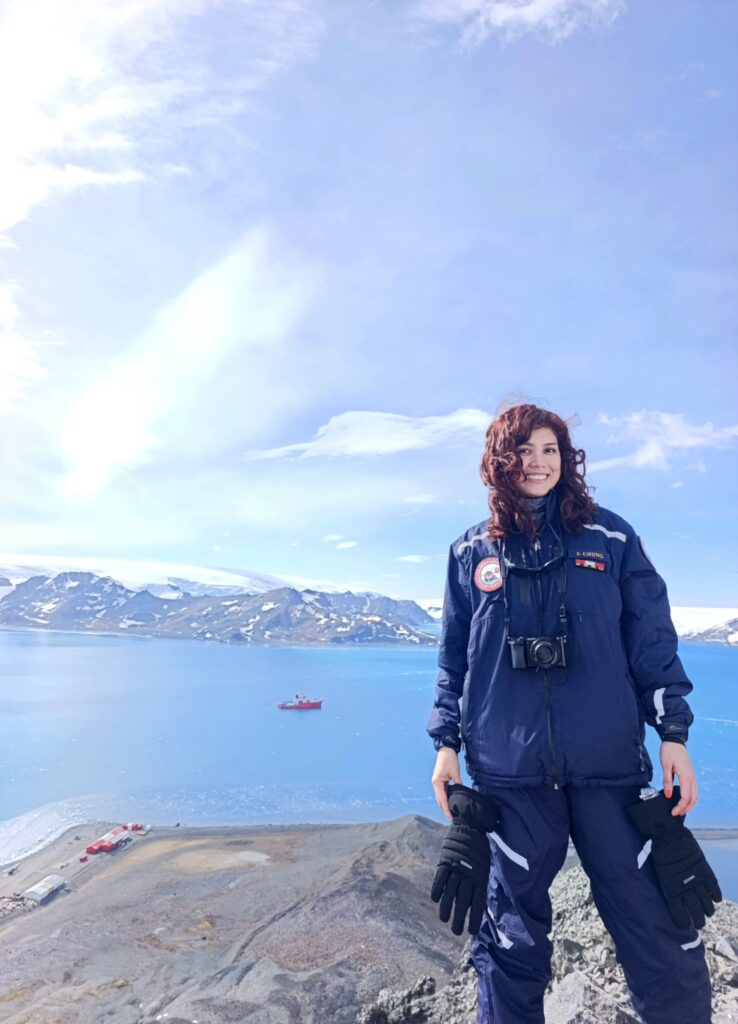
Sofia worked aboard the BAP Carrasco during the XXXII Peruvian Antarctic Expedition, supporting scientific activities and experiments focused on Antarctic krill and its responses to environmental stressors. She stepped onto the actual Antarctic continent near the Peruvian scientific station Machu Picchu. As a young researcher, standing on that shelf connected all the long lab shifts to the raw reality of the ecosystem they are working hard to understand and protect experiencing firsthand the environment that she had come to Antarctica to study as a marine biologist.
What’s the work that you do?
I am a marine biologist working on the study of marine organisms, more recently I participated in the expedition to Antarctica to study krill and how black carbon could have an impact in their physiology, with a focus on their distribution, ecology, and response to environmental change. I have participated in Antarctic research, where I contributed to field and laboratory work under extreme conditions. My work combines field experience, data analysis, and scientific synthesis to better understand marine biodiversity and its role in changing ocean systems.
What keeps you going?
What keeps me going is the combination of curiosity and feeling. I’m driven by the need to understand marine life, but also by the emotional connection I feel when working in the field.
Moments like observing organisms in extreme environments, or overcoming challenges as a team in Antarctica, remind me why I chose this path. It’s not always easy—research can be demanding and uncertain—but knowing that my work contributes, even in a small way, to understanding and protecting marine ecosystems keeps me moving forward.
What’s your message to the world?
The polar regions are not distant, frozen frontiers—they are living systems that reflect the health of our entire planet. Working in Antarctica taught me that science is not only about data, but about resilience, collaboration, and humility in the face of dynamic environments.
My message is simple: we need to care, not just understand. Protecting these ecosystems requires both rigorous science and emotional connection. The more we allow ourselves to feel what is at stake, the more responsibility we take for the future we are shaping.
Organisation: Universidad Nacional de Piura (Peru)
Nationality:
 Peru
Peru
Disciplines: