Stefanie Martinez, MSc
University of the Republic (Uruguay)
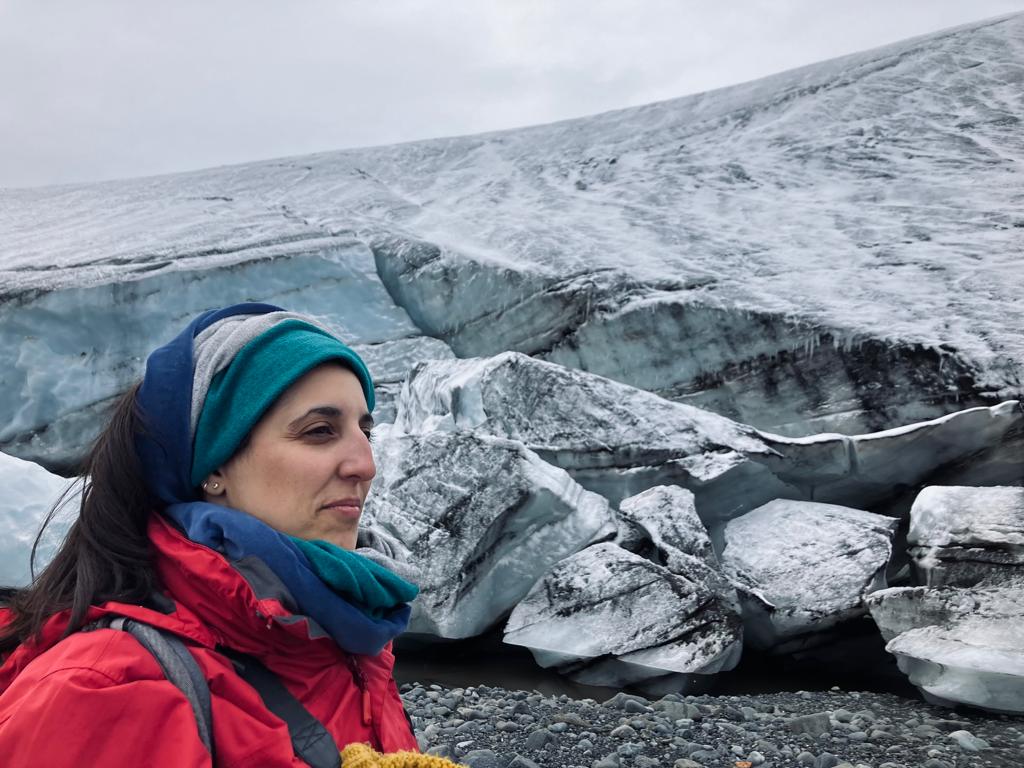
Picture of Stefanie taken in Antarctica, in front of Collins Glacier (Collins Bay), near Uruguay's Artigas Scientific Station.
What’s the work that you do?
I am a Biochemist and Master of Geosciences researcher focused on marine biogeochemistry. My work explores how organic matter is produced, transformed, and transferred between the water column and seafloor, particularly in Antarctic fjord ecosystems. I analyze molecular markers through biogeochemical approaches to understand ecosystem functioning and carbon cycling. My research also examines benthic-pelagic coupling and how environmental changes, such as glacier retreat, influence these processes. In parallel, I engage in science communication, designing and delivering workshops and activities that make science accessible to children and the broader community.
What keeps you going?
I’m driven by curiosity about how the ocean works at a molecular level and how these processes shape entire ecosystems. I enjoy connecting small-scale biogeochemical signals with large-scale environmental change, especially in vulnerable systems like Antarctic fjords. Knowing that this work contributes to understanding climate impacts and carbon cycling gives it purpose. I also value the creative and collaborative side of science, and the opportunity to communicate it, especially to children, so others can feel that same sense of wonder and responsibility towards the ocean.
What’s your message to the world?
The smallest molecules can tell the biggest stories. In places like Antarctica, tiny chemical signals reveal how life responds to a rapidly changing planet. If we learn to read them, we gain not only knowledge, but responsibility. The polar regions may feel distant, but they are deeply connected to the systems that sustain us all. My message is simple: stay curious, protect what you don’t fully understand yet, and remember that even the most invisible processes can shape the future of our world.
Organisation: University of the Republic (Uruguay)
Nationality:
 Uruguay
Disciplines:
Connect: