
Susana Flecha, PhD
Instituto de Ciencias Marinas de Andalucía (ICMAN), Consejo Superior de Investigaciones Científicas (CSIC), Spain
What’s the work that you do?
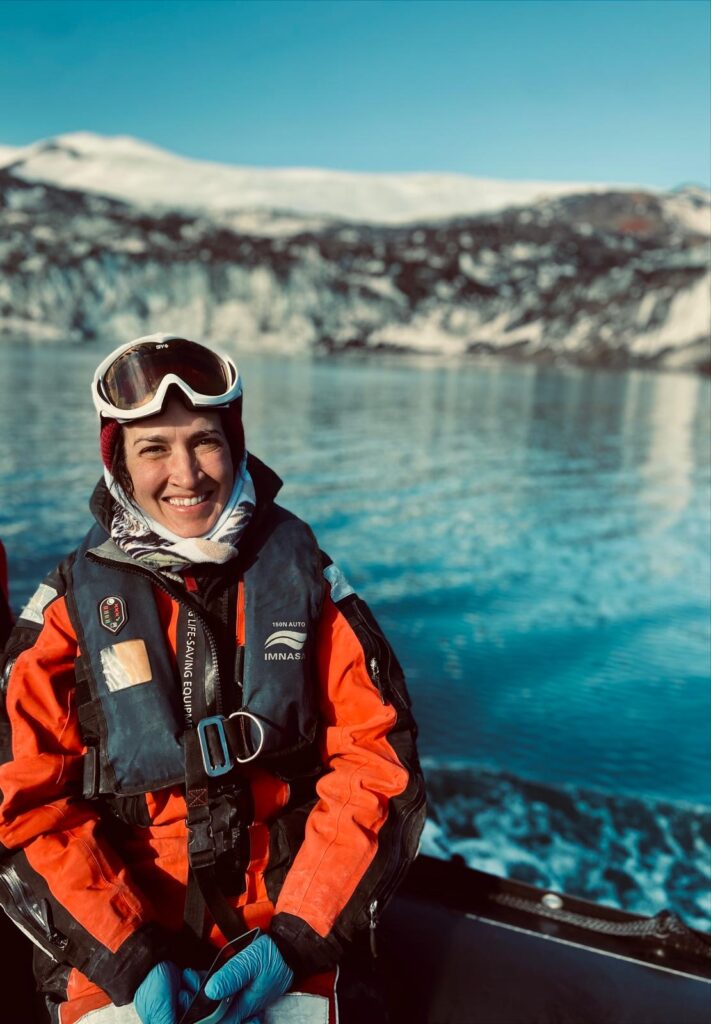
I chase invisible gases in the coldest waters on Earth. As a marine biogeochemist, I measure how much carbon dioxide, methane and nitrous oxide the Antarctic Ocean breathes in and out – the very gases that decide the future of our climate. I have already lived three Antarctic summers on the ice, and I’ll be back in 2027. To make sense of the enormous datasets we bring home, I lead OCEAN–IA, a research line that teaches Artificial Intelligence to read the chemistry of polar oceans, fill the gaps between samples, and forecast change before it becomes irreversible.
What keeps you going?
The Southern Ocean is loud. The wind, the ice breaking, the penguins, the engines – and underneath it all, a quieter signal that very few people get to listen to: the signal of a biogeochemistry that controls the planet’s climate. What keeps me going is being one of the people who gets to listen. The thrill of a clean dataset after a brutal day at sea, the moment a machine-learning model finally clicks, the laughter experienced with other women on a Zodiac. And, above all, the conviction that what we learn down there matters everywhere else.
What’s your message to the world?
Polar oceans absorb roughly a third of the carbon dioxide humanity emits and store most of the excess heat we generate. We rarely thank them for it, and we are approaching their limits faster than most people realize.
After three Antarctic campaigns, I have learned that good polar science is rarely heroic. It is patient, collaborative and well documented: long-term observations, open data, and methods – including Artificial Intelligence – that help us understand what isolated samples cannot. The data we collect today will serve as the baseline that future generations use to measure how much we changed or how much we managed to protect.
I also believe polar science becomes better when it becomes more diverse. Marine biogeochemistry includes brilliant women who have shaped how I think and work, and I hope the next generation finds even more of us across every corner of polar research. To anyone reading this who has ever wondered whether they belong in this kind of work: you do, and we need you here.
If I had to leave a single message, it would be this: protect what regulates our climate, support the people who quietly observe it year after year, and trust that curiosity – wherever it comes from- is one of the most useful tools we have left.
Organisation: Instituto de Ciencias Marinas de Andalucía (ICMAN), Consejo Superior de Investigaciones Científicas (CSIC), Spain
Nationality:
 Spain
Spain
Disciplines:
Connect: