
Tengku Nilam Baizura Tengku Ibrahim, PhD
Universiti Teknologi MARA (Malaysia)
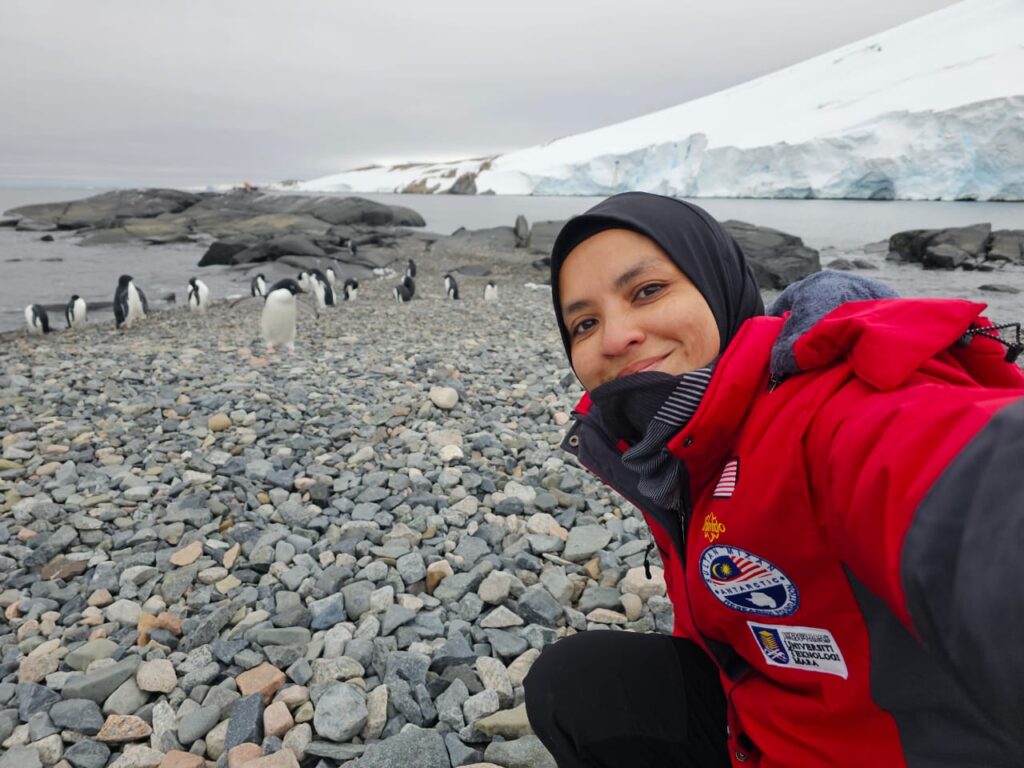
Tengku is at Horseshoe Island, Antarctica, in February 2025, during her Antarctic research expedition. The curious Adélie penguins were their regular companions, always there to greet the team while they worked — one of her favourite memories from Antarctica.
What’s the work that you do?
I’m a Senior Lecturer in Environmental Health at Universiti Teknologi MARA, Malaysia. My work mainly focuses on water quality, waste management, environmental contaminants, and polar environmental health. Recently, much of my research has been centred on microplastics, rare earth elements, and trace metals in Antarctic aquatic ecosystems. Looking at how these pollutants move in the environment, build up in living organisms, and what risks they may pose under changing climate conditions. I’m also interested in practical environmental solutions, especially sustainable technologies that can help reduce pollution. Through fieldwork, lab work, and collaboration with researchers from different countries, I hope my work can contribute, even in a small way, to better understanding and protecting fragile polar ecosystems.
What keeps you going?
What keeps me going is simply curiosity and the feeling that there is always something new to learn. Working in polar research, especially in Antarctica, reminds me how much of our world is still waiting to be understood. Being able to contribute, even in a small way, feels meaningful to me. I also believe research should go beyond papers and publications, it should create awareness, guide better decisions, and inspire students to explore science. Coming from Malaysia, I hope my journey shows that researchers from our region can also play a role in global polar science, and hopefully inspire more young women to believe they can too.
What’s your message to the world?
The poles may seem distant, but what happens there shapes all of us. Ice, oceans, pollutants, and ecosystems are deeply connected across borders. Protecting polar environments is not only about conserving remote landscape. It is about understanding our shared future. Science must remain collaborative, inclusive, and courageous. Coming from a tropical country like Malaysia, I never imagined that my path would one day lead me to Antarctica. That has taught me something important that meaningful science can come from anywhere. Stay curious, stay grounded, and keep going. Sometimes the places we never imagined reaching become the ones that change us the most.
Organisation: Universiti Teknologi MARA (Malaysia)
Nationality:
 Malaysia
Disciplines: