Virginia Morandini, PhD
Doñana Biological Station, Spanish Research Council
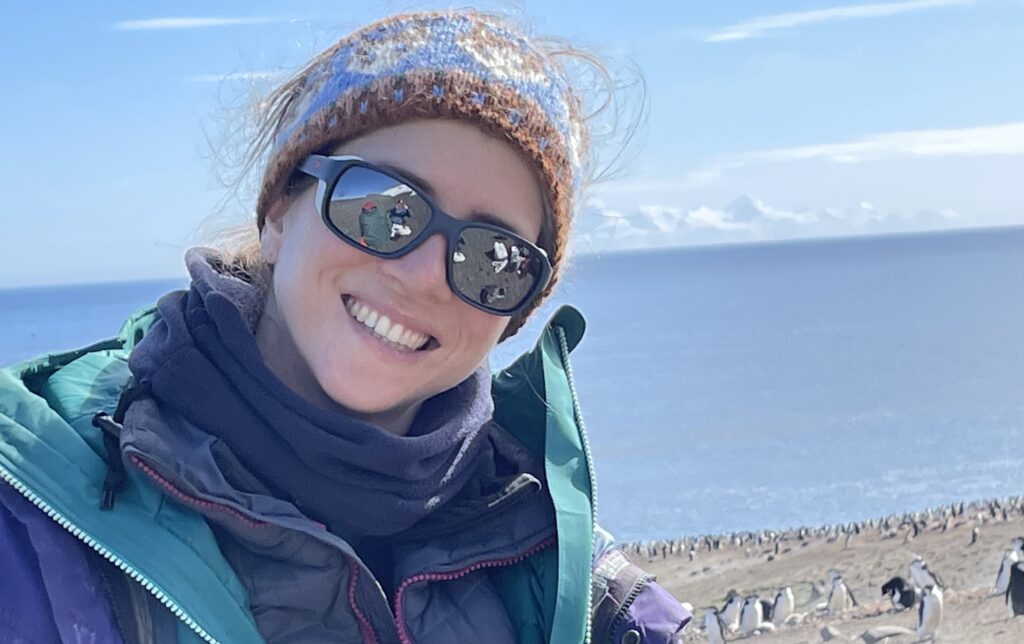
Virigina is in font of the Vapour Col penguin colony, Deception Island, Antarctica, during fieldwork on Antarctic penguins.
What’s the work that you do?
My work focuses on Antarctic seabirds, especially penguins, as sentinels of environmental change. I study how their movement ecology, foraging behaviour, breeding performance, health, parasites and diet reflect changes in polar marine ecosystems. I combine long-term field monitoring, biologging, stable isotopes, camera-trap data and ecological modelling to understand how Antarctic predators respond to climate change, fisheries, disease risk and other human pressures. My broader goal is to strengthen the use of Antarctic wildlife data for conservation, ecosystem monitoring and decision-making, while building collaborative research networks that connect field ecology, disease ecology and polar governance across international Antarctic research communities.
What keeps you going?
My motivation comes from the feeling that polar ecosystems are changing faster than our ability to understand and protect them. I love field ecology because it connects rigorous science with real places, real animals and real consequences. Penguins are not just charismatic species; they are powerful sentinels of what is happening in the Southern Ocean. What keeps me going is the possibility that good science, if better connected to monitoring and decision-making, can help anticipate change rather than simply document loss. I also care deeply about building collaborations that make polar research more useful, honest and collective.
What’s your message to the world?
Most of the world lives with its back turned to Antarctica, as if what happens there were remote from our daily lives. But Antarctica is not separate from us. It regulates climate, stores memory in ice, sustains unique ecosystems and reveals, earlier than most places, the consequences of our choices. My message is that we cannot afford to notice Antarctica only when something has already been lost. Science must help society look ahead, connect knowledge, and act before damage becomes irreversible. The polar regions are not empty or distant; they are one of the clearest mirrors of the future we are creating.
Organisation: Doñana Biological Station, Spanish Research Council
Nationality:
 Spain
Spain
Disciplines: