
Marianne Heberlein, BSc
University of Alabama (USA)
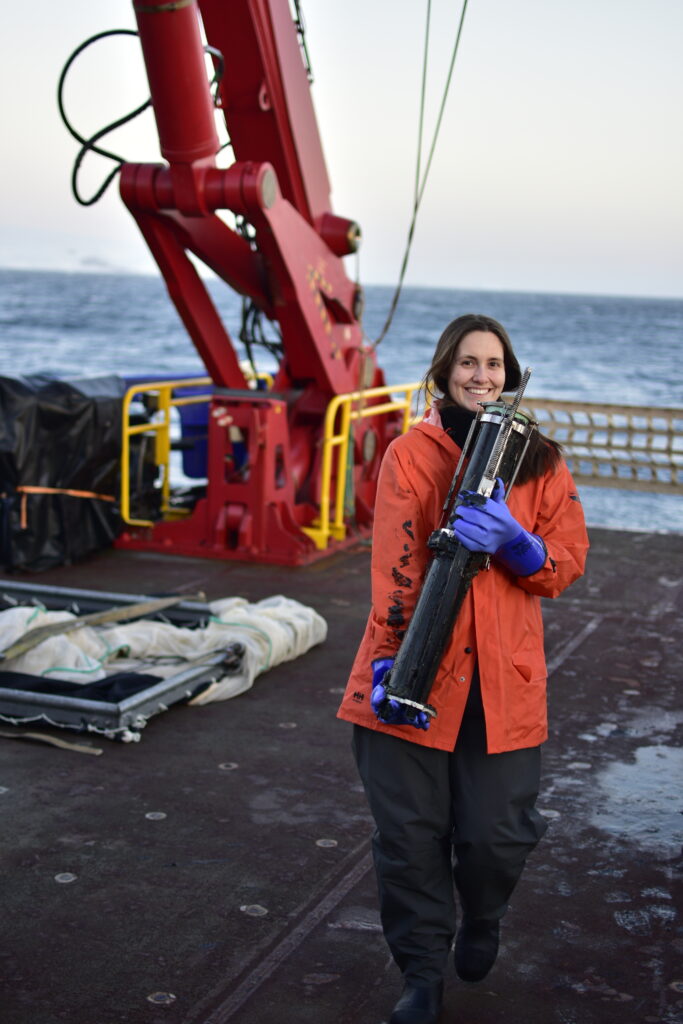
This photo was taken on board a vessel in the Firth of Tay, Antarctic Peninsula. Marianne was collecting a multi-core with the team of the SKQ2602.
What’s the work that you do?
My work is focused on understanding past environmental changes in the Amundsen Sea sector of West Antarctica. Working with marine sediment cores, I use stable isotopes, microfossils, and sedimentology to determine changes in the oceanography and climate.
As part of my Ph.D. research, I am studying radiocarbon reservoirs in the Amundsen Sea Embayment and how different radiocarbon calibration methods change our understanding of time.
What keeps you going?
I like to think of my Ph.D. as a crime scene where you have to figure out how all the small details come together to tell a story. For me, it’s every little “click” moment, when the data makes sense, that keeps me going. I love microfossils and stable isotopes, and in my opinion, they are the best storytellers we can use to reconstruct the past.
What’s your message to the world?
As my advisor, Dr. Totten, likes to say: “What happens in Antarctica does not stay in Antarctica.” Although Antarctica might sound like a far-off, almost mystic place to some, glaciers, like Pine Island or Thwaites, are rapidly melting, and this is affecting coastal cities all around the world. Even here in Alabama!
Organisation: University of Alabama (USA)
Nationality:
 Chile
Chile
Disciplines: